


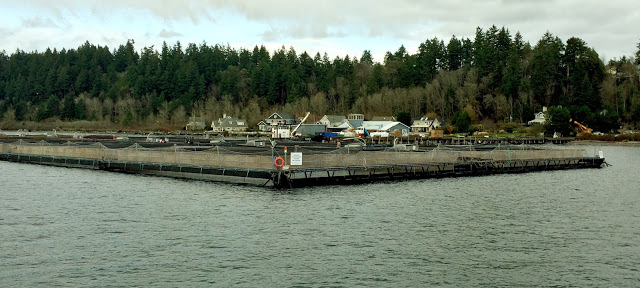
OLYMPIA – Citing the risk of fish disease transmission, the Washington Department of Fish and Wildlife has denied permission for Cooke Aquaculture to transport 800,000 juvenile Atlantic salmon from its hatchery near Rochester to net pens at Rich Passage in Kitsap County.
In late April, Cooke applied for permission to move juvenile non-native salmon from its hatchery into pens in Kitsap County to replace adult fish that were recently harvested. Washington lawmakers enacted a bill earlier this year that will phase out Atlantic salmon aquaculture by 2022, but Cooke plans to continue to operate until then.
WDFW officials cited two factors in denying the permit that they said would increase the risk of disease transmission within the net pens and possibly to wild and hatchery-raised Pacific salmon outside the pens:
- The population of Atlantic salmon that would have been transported from Cooke’s hatchery near Rochester tested positive for a form of the fish virus PRV (piscine orthoreovirus) that is essentially the same as the PRV that occurs at the Iceland hatchery from which Cooke receives Atlantic salmon eggs. The Icelandic form of PRV is not known to occur in the eastern Pacific Ocean or Puget Sound, so WDFW classifies it as “exotic” in Washington.
- Cooke proposed to place fish into pens that have not been empty (or “fallow”) for at least 30 days after the most recent harvest of adult fish, and within a farm that still contains adult Atlantic salmon. These actions would contradict the company’s own management plan.
“Each of these factors raised an unacceptable risk of introducing an exotic strain of PRV into Washington marine waters,” said WDFW fish health manager Ken Warheit. “This would represent an unknown and therefore unacceptable risk of disease transmission.”
Warheit said samples of the juvenile fish that would have been transported were collected by an independently licensed veterinarian under contract with Cooke. The samples were tested for PRV at the Washington Animal Disease Diagnostic Laboratory at Washington State University. Test results were confirmed at the U.S. Geological Survey’s Washington Fisheries Research Center.
Until recently, Cooke operated up to nine net pens in Puget Sound, including one at Cypress Island in Skagit County that collapsed last August and allowed approximately 250,000 Atlantic salmon to escape. The company’s latest permit application is not related to the Cypress Island operation or the August mishap.